


The lesson we can all learn from the Billie Eillish & Justin Bieber Saga
If you didn't see it, let me set the scene.
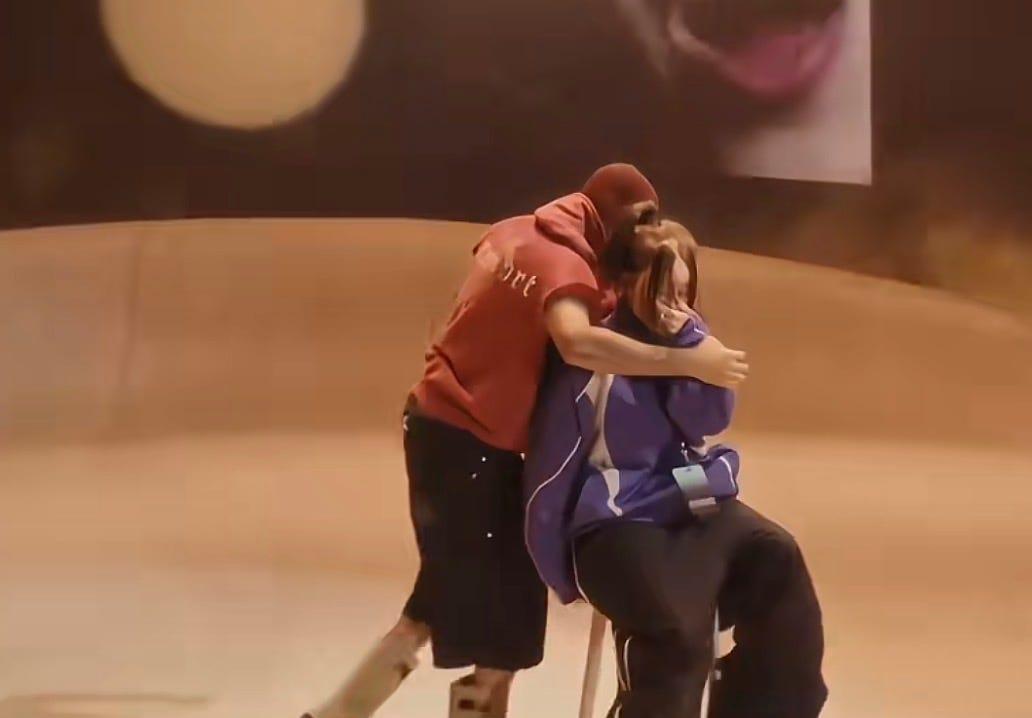
Weekend two of Coachella. Justin Bieber is headlining. He gets to "One Less Lonely Girl" — the same song from 2009 where, as tradition, he pulls a girl from the crowd and serenades her on a stool. Except this time, the girl is Billie Eilish. And Hailey Bieber, standing next to her in the VIP box is the one who pushes her onto the stage.
Billie can barely climb up. She's collapsing. Covering her face. Laughing in disbelief. Because the twenty-four-year-old standing there is also, still, the eight-year-old with Justin Bieber posters wallpapered across her childhood bedroom. The one who once said, on camera, that if she ever got a boyfriend she wouldn't be able to focus on him because she'd be thinking about Justin the whole time.
I watched that clip and I couldn't stop thinking about one thing:
The obsession was the information.
What a childhood bedroom is actually telling you
Here is what I want you to understand, because I think we've spiritualized this idea so much that it's lost its edge:
The things you were obsessed with as a child were not random. They were not a phase. They were not "cute little interests." They were data. They were a transmission. A signal about a life you were built to live, a life that, at that age, you had no reason to filter, no reputation to protect, no market to perform for.
You just loved what you loved.
And then somewhere between ten and twenty-five, most of us were taught to stop trusting that. We were taught that passion is impractical. That the thing that lights you up is a hobby, and the thing that pays the bills is your life. So we put the posters in a box. We picked a reasonable major. We took the stable job. We told ourselves we'd come back to it later.
And then "later" became a pattern.
Billie Eilish did not put the posters in a box. She didn't shrink the obsession into something more palatable. She followed the frequency of it . And the miracle of that Coachella moment is not that she got serenaded. It's that she was in the room at all. She was there because she kept moving toward the thing she loved, one small decision at a time, for fifteen years.
The obsession was pointing the whole time.
Obsession isn't always about the thing. It's about the frequency underneath it.
This is the part I think gets missed.
Billie Eilish wasn't destined to marry Justin Bieber. The literal object of the obsession is not always the destination. What the obsession is really telling you is the frequency you're tuned to— the emotional, aesthetic, spiritual territory that is yours to live inside.
For her, it was music. Performance. Emotional intensity. The world Justin Bieber represented as a kid wasn't really about him it was about that life being possible for someone like her.
So when you look back at what you were obsessed with, don't take it so literally. Ask:
What was the feeling I was chasing?
What kind of world did I want to be inside?
Who did I want to become in proximity to that thing?
That's where the information lives. Not in the object, but in the resonance.
A small practice: The Obsession Inventory
Before you close this tab, I want you to actually do this. It takes maybe fifteen minutes and it's one of the exercises I use with my clients.
1. List five things you were obsessed with before the age of twelve. Books. Shows. People. Places. Smells. Subjects. Games you played alone. Things you re-watched or re-read until your parents were concerned. Don't edit for dignity.
2. Next to each one, write one sentence: What was the feeling I got from this? Not what it was. How it made you feel. "Powerful." "Seen." "Like I was somewhere else." "Like I was finally home."
3. Look for the repeating word. Every person I have ever done this exercise with finds a pattern. A frequency. One or two words that keep showing up under completely different objects. That pattern is the signal. That's the information.
4. Ask: Where in my current life am I living on that frequency? Where am I refusing to?
I will tell you right now, most of you already know the answer before you finish question three.
The thing you call "unrealistic" is usually just unfamiliar
The reason we ignore the obsession isn't because we don't know what it's telling us. It's because we know exactly what it's telling us, and the life on the other side of that knowing requires us to become someone we haven't met yet.
The obsession is patient. But it is also persistent. It will keep showing up as a lump in your throat every time you see someone else doing the thing you were built to do. It will keep showing up as that ache on Sunday nights. It will keep showing up as the tab you open and close without clicking apply.
Billie Eilish's version of that could have been any one of a thousand reasonable decisions. Don't pursue singing, it's a long shot. Don't move toward that world, it's not practical. Don't take yourself that seriously. She made a different decision. And a different decision. And another one. And the accumulation of those decisions is what put her in the front row of a Coachella VIP box next to the wife of the man whose face was on her wall. The irony of it all lol
This is what Body of Work is about
Next week on Substack, I'm releasing the full teaching from Body of Work, my 5-day creative direction intensive. And this is what Day 1 is built on.
The premise of Body of Work is that your brand, your business, your creative life does not come from strategy. It comes from excavation. It comes from going back to the frequency you were born tuned to, pulling out the data that's been there since you were eight years old, and building a body of work that only you could have made.
Everyone is telling you to pivot. Fix your funnel. Fix your messaging. Niche down. Post the money screenshots. Copy the template.
What nobody is telling you is that the most essential part of your brand — the only part that is not replicable — is your perspective. Your lens. The thing the eight-year-old version of you already knew. And you cannot market your way into that. You have to return to it.
Body of Work is the return.
I'll be dropping the full teaching here on Substack next week, free, so make sure you're subscribed so it lands in your inbox


